Showing posts with label Greek. Show all posts

Sunday, September 08, 2024

Hierapolis: A Sacred City of Ancient Greece and Rome

Hierapolis, an ancient city, was established as a Greek colony in the late 3rd and early 2nd century BC, atop an older settlement on a travertine plateau. It was founded by Eumenes II, king of Pergamon, who chose the location for its natural hot springs, famed for their healing qualities, drawing visitors from afar.

The city's name likely comes from Hiera, the wife of Telephus, an ancestor of the Pergamene kings. Alternatively, "Hierapolis," meaning "Holy City," may refer to the many temples within its boundaries. The most prominent of these was the Temple of Apollo, built along an active fault line, symbolizing the link between divine forces and nature.

In 133 BC, after the death of Attalus III, the last Pergamene king, Hierapolis became part of the Roman Empire. Under Roman rule, the city thrived as a center of arts, philosophy, and trade. The Romans enhanced the city's infrastructure, adding grand theaters, baths, and public buildings that reflected their architectural skill.

During the Byzantine era, Hierapolis evolved into a key Christian site, with the Apostle Philip believed to have been martyred there. A martyrium was built in his honor, cementing the city's role as a pilgrimage destination.

After a series of destructive earthquakes in the 14th century, the city was eventually abandoned. Today, its ruins, including a well-preserved theater, necropolis, and Pamukkale’s famous travertine terraces, continue to attract tourists and scholars, offering a glimpse into its storied past.
Hierapolis: A Sacred City of Ancient Greece and Rome

Saturday, February 17, 2024

The Greek city of Thebes: History Overview

The Greek city of Thebes, positioned to the north of the Cithaeron range and along the southern edge of the Boeotian plain, occupies a prominent position in both myth and history. According to legend, Cadmus, in pursuit of Europa, whom Zeus had abducted, founded Thebes after settling in Greece. Allegedly, he constructed a seven-sided citadel, remnants of which have been uncovered by archaeologists.

Across its historical trajectory, Thebes wielded significant influence over the Boeotian region, though its apex was disrupted by Alexander the Great's conquest in 335 BC. Despite facing destruction, Thebes remained a pivotal entity in Greek history, leaving a lasting imprint on the cultural and political milieu of the era.

Famed for its formidable military, Thebes played a pivotal role in various conflicts, notably the Persian Wars. Initially aligned with fellow Greek city-states against Persian incursions, Thebes later realigned itself with Persia, opposing Athens and Sparta. The city suffered a decisive setback in 479 BC at the Battle of Plataea, marking a notable setback in its military endeavors.

The pivotal moment in Thebes' military narrative unfolded at the Battle of Leuctra in 371 BC. Led by Epaminondas, Theban forces triumphed over the Spartans, catapulting Thebes to a position of supremacy within Greece. Epaminondas' strategic acumen and innovative tactics consolidated Thebes' dominance, albeit fleetingly, reshaping the regional power dynamics.

Yet, Thebes' supremacy proved short-lived. Epaminondas' demise in 363 BC exposed the city to external threats. In 338 BC, Thebes suffered a grievous blow with the defeat of the Sacred Band at the hands of Philip II and Alexander the Great's forces in the Battle of Chaeronea.

Despite its downfall, Thebes' legacy endures. Its mythical origins, historical significance, and military prowess continue to captivate scholars and enthusiasts alike. The rise and fall of Thebes serve as a poignant testament to the ever-shifting tides of power in ancient Greece, leaving behind a rich tapestry of cultural heritage and historical intrigue for future generations to explore.
The Greek city of Thebes: History Overview

Saturday, April 08, 2023

Ancient city of Argos

Ancient city of Argos was one of the foremost Mycenaean cities of the Peloponnesus. The city of Argos (13 km far from Mycenae), today an agricultural and industrial center of the Argolis Prefecture, was one of the most prominent city-states from the beginning of Archaic Times (c. 800 B.C.) and through to Classical Times.

Named after Argus, one of the many children of Zeus and Niobe, Argos endured through the Bronze and Dark Ages, Classical and Hellenistic periods, and the rule of Rome, right up to Frankish and Turkish times.

Ancient Argos was built in the Late Bronze Age and situated just five kilometers from the coast on the west side of the fertile Argolid plain in the Peloponnesus, well-watered by two rivers from neighboring mountains, Larissa and Aspis, lies this enduring polis of great bounty and agricultural wealth.

But in antiquity this kingdom was a mighty rival of Sparta and there were more than 30. 000 inhabitants when Christianity came.

Most of the food was imported from other countries and city-states such as Italy, Sicily, Egypt and other city states. They invented silver coins to buy things. These coins were supported by the government and helped Argos foster a thriving marketplace.

Argos would take a position of neutrality during the earlier Persian Wars – though arguably displaying pro-Persian sentiment – and Argos did not join the Hellenic League in 481 BC.

Early in the seventh century BC, King Pheidon defeated the Spartans, presided over the Olympic Games, and made Argos the first power in Greece. This burst of power receded in the sixth century to Spartan dominance, with the Spartans taking control of Thyrea in 545 BC at the Battle of 300 Champions.

The modern city of Argos is mainly built on this elevated surface on top of the ancient habitation ruins brought to light during excavations of the French Archaeological School and the 4th Ephoria of Prehistorical and Classical Antiquities.
Ancient city of Argos

Friday, May 06, 2022

Acropolis of Athens

The Athenian acropolis, located on a craggy, walled hill, was built as a home of Athena, the patron goddess of the city. The hill has been inhabited since the 4th millennium BC. Iktinos and Kallicrates who were the architects along with Phidias, the famous Greek sculptor, built the incredible monuments of the Acropolis.

Iktinos was an architect active in the mid-5th century BC while Callicrates was an ancient Greek architect active in the middle of the fifth century BC.

Strong fortification walls have surrounded the summit of the Acropolis for more than 3,300 years. The first fortification wall was built during the 13th century BC, and surrounded the residence of the local Mycenaean ruler.

In the 8th century BC, the Acropolis gradually acquired a religious character. The older Parthenon or the Pre-Parthenon was built around 500 BC using Piraeus limestone. The Parthenon was built as a temple, dedicated to the goddess Athena, the patron of Athens.

Democracy was established in Athens around 500 B.C. It was based on a direct democracy system, in which eligible citizens directly voted on laws.

In the late 1600's, the Venetians and Turks were fighting over Athens. Acropolis was used as a military point because of its high position. After the Ottoman conquest, the Erechtheion was converted into the Governor’s private harem and the Parthenon was used to garrison the Turkish army.
Acropolis of Athens

Tuesday, September 18, 2018

City of Sparta

Long before the city of Sparta arose, the fertile and rain-nourished Laconian plain was home to pre-Greek inhabitants in the third millennium BC and to Mycenaean Greeks in the second millennium BC.

Sparta was founded by descendants of the Dorian Greeks who overran most of the Peloponnesian around 1100-1000 BC after the collapse of Mycenaean Civilization.

In the classical period, Sparta itself was never a large city like Athens. Instead, its “urban core” consisted of a clump of four villages. The Spartans were warriors, not builders, and had little use for the architectural grandeur, theaters, or high culture of Athens.

Spartans were suspicious of outsiders and their ideas. They grew much of what they needed in the fertile soil around Sparta. What they couldn't grow, they often Look from their neighbors through the power of their armies.

It was primarily a military state. Its government was an oligarchy in which a few men held most of the power. The Spartan economy depended on farming and conquest. Boys and girls alike were educated to protect the city-state. Beginning at the age of 7, young boys were sent from their families to live in military barracks. They were treated harshly to make them tough so that they would be a fierce fighting force when they turned 20.

Over the years, the Spartans’ ruthless and brutal reputation in war grew, so that other nations and city-states chose not to attack Sparta, even though the Spartan army was not larger than eight thousand men. The Spartan men in the army started their military training at the age of seven and were trained to be tough.

In 404 B.C. the Spartan army was able to conquer Athens during the Peloponnesian War. After its victory over Athens, the Spartan government was able to counter many attacks that were launched by its enemies and maintained power for over 40 years. The city was annexed by Achaea league in 192 BC.
City of Sparta

Sunday, August 13, 2017

History of ancient city Corcyra

Corcyra is a Greek Island in the Ionian Sea close to the west shore of Epirus province. It is now called Corfu; was first peopled by a colony for Colchis, 1349 BC and afterward by a colony from Corinth.

Corinth people with their chef Chersicrates, came to settle there, on being vanished for their native city 703 years before the Christian Era. Homer call them Phaeacians

Corcyra is said to have been first known by the name of Drepane, perhaps from its resemblance in shape to a scythe.

To this name succeeded that Scheria, always used by Homer and by which it was known in his time.
From the Odyssey, it was written that the island inhabited by Phaeacians, a people who, even at that early period, has acquired considerable skill in nautical affairs, and possessed extensive commercial relations, since they traded with the Phoenicians and also with Euboea and other countries.

Corcyra was established by Corinthians. It was one of the earliest Greek colonies, founded in 734 BC by settlers from Corinth.

Corcyra rapidly rose to be one of the first maritime powers in Greece. Corcyra’s naval station was one of the first to be constructed in the Mediterranean at the end of the archaic period and the beginning of the fifth century BC, in order to house a spectacular navy of c. 200 triremes.

Corcyra enjoyed local trade with the Illyrians, who supplied silver ore, timber, slaves, tin and wildflowers.
Unlike most Greek colonies, Corcyra rebelled violently against its mother city. Later the Corinthians compensated for a Corcyrean rebellion by creating new northwestern colonies, including Ambracia, Apollonia and Leucas (630-600 BC).

The city was occupied variously by Macedonians, Syracusans, Epirotes and Illyrians before passing to the empire of Rome in 229 BC, and serve many years as a Roman naval base.
History of ancient city Corcyra

Friday, January 06, 2017

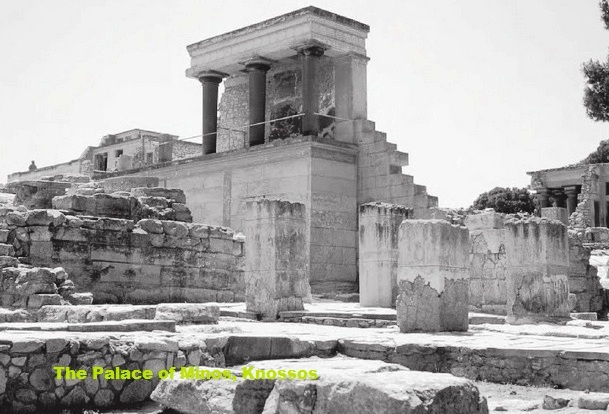
Knossos

Knossos lies in the centre north of Crete, two hours’ walk from the sea: set amongst low hills, on fertile marly soil and well enough watered.

This was a combination that attracted the Neolithic settlers, around 7000 BC and led to their creating over the next three millennia a substantial tell and the largest of their settlements on the island. Though Knossos has yielded evidence of habitation fro quite early date and from Hellenic Greek and Roman times, it is most important for its Minoan Bronze Age material.

Evidence of the Minoan civilization that flourished on the island of Crete between 3000 and 1100 BC comes from Greek legend, which tells of the wealth of Crete in the time of King Minos.

His palace at Knossos was said to contain a complex underground labyrinth occupied by the minotaur - a monster that was half man, half beast.

Young Greek men and women were left in the labyrinth as human sacrifices until Theseus, prince of Athens, slew the minotaur and escaped with the help of Minos’ daughter Ariadne.

Knossos rise was gradual, though by 2000 BC the settlement was nearly as extensive as it ever was and already centered on the monumental structure, replaced by the First Palace.

Between the 18th an 17th centuries BC Knossos was damaged and several other places were completely destroyed possibly due to earthquake or war.

The Second Palace was erected in 1700 BC after an earthquake destroyed an earlier structure: its prosperity and vigor were shared islandwide; Minoan dominance was evident on the Cyclades and culturally influential in southern Greece.

Destroyed for the last time by fire, probably in the 14th century BC, the decline of Knossos was echoed by the deterioration of Cretan art into more crude and less imaginative style.

After the Early Christian and Byzantine periods, Knossos was once again deserted. With the Arab conquest of 827, nearby Herakleion became the more important site.
Knossos

Tuesday, June 09, 2015

City of Delphi

The ancient city of Delphi lies immediately to the east of the modern town of Delphi, the former Kastri.

The city of Delphi had been in existence for centuries when in the seventh century BC, it became the capital of the association of Greek states known as the amphictyony. It is a powerful coalition of central Greek states.

The name Delphi may commemorate Apollo’s cult title Delphinios (meaning dolphin or porpoise).

In the middle of the century, a temple to Apollo was erected at Delphi to celebrate the god’s victory over large snake, the python.

Ancient Delphi was the seat of the oracle of Delphi, who made prophecies that effected many events in Greek history; it was an important cultural as well as a religious center.

The site was abandoned after the Orthodox Christian Byzantine Emperor Thoedosius I of Rome ordered all ‘pagan’ celebrations to be abolished, forever.

Delphi was also the location of quadrennial Panhellenic Games which included musical and poetical as well athletic and equestrian contests.
City of Delphi

Wednesday, April 15, 2015

Ancient city of Ephesus

Ephesus, which became the greatest city of Asia Minor, was a center of Hellenism for over 2000 years. It was founded by Androclus, son of the king of Athens, around 1050 BC.

From around 1000 to 550 BC the city of Ephesus was located at the northern based of Mt. Pion, near the place where the Cayster River met the Aegean Sea; from 550 BC, it was situated near the Artemisium.  Ephesus was one of the Greek world’s foremost cities during the Ionian heyday of the 600s and 500s BC.

Croesus of Lydia conquered the city in 560 BC, and moved its inhabitants to a new site near the new temple of Artemis, which he adorned with elaborate columns.

In the third century BC Ephesus was in turn under the Seleucids and the Ptolemies of Egypt.  After the defeat of Antiochus III, the city was made subject to the rule of Eumenes II in 188, and seems to have flourished under Pergamene rule.

Ephesus can under the control of Rome after Attalos III of Pergamum bequeathed his kingdom to the Romans in 133 BC, although Ephesus was granted its freedom by Rome. Ephesus reached its height under the Roman Empire, when it was the residence of the proconsul of Asia and set of the imperial cult.

The town was finally destroyed in civil wars in the early 15th century. In the Ottoman period only a few Greek Christians remained in a declining town that suffered from malaria and nomadism.
Ancient city of Ephesus

Monday, March 23, 2015

Ancient Crotone

Crotone was founded by colonists from Achaeans around 710 BC. Crotone became an extremely successful community, perhaps assisted by nearby silver deposits.

By the sixth century BC, it had gained some fame as the home of a medical school, of the great Olympic wrestler Milo of Crotone, and of Pythagoras, the philosopher who moved there from Samos and became a political leader by opposing popular government.

Milo of Crotone or Milo the strongman was a champion in wrestling at the Olympic and Pythian Games.

Pythagoras was the reformer of customs, moral and political, not only at Crotone but in several other the Italico-Greek cities.

As the only real port between Taranto and Reggio, Crotone prospered and in 510 Crotone’s army, under Milo’s command, defeated its hated neighbor Sybaris.

Crotone soon was weakened by conflicts with two other Italian Greek cities, Rhegion and Locri, and with the Brutii.

Crotone was captured and plundered in 379 BC by the Syracusan ruler Dionysius.
Ancient Crotone

Monday, February 09, 2015

Ancient Corinth

Located in the narrow isthmus that connects southern and central Greece, Corinth prospered in large part because of its geography.

Its twin ports, one on the Aegean Sea and one on the Ionian side enabled it to trade throughout the Mediterranean.

The area of ancient Corinth was occupied continuously from the Late Neolithic period through the Bronze and Iron Ages.

Ancient Corinth was an independent city-state governed by a constitution based on oligarchy, which flourished during the time of overthrow of the tyrants.

The city’s peak of prosperity came in the 600s and early 500s BC when its international shipping network came to dwarf those of other mainland Greek cities.

Although it lost this preeminence to Athens in the fifth century BC, Corinth remained a center for commerce and luxury throughout ancient history.

After the Battle of Chaeronea in 338 BC, and following the defeat of Athens and Thebes, Corinth was chosen by Philip II of Macedon as the locale for the great conference he called to decide the future relationship between the Greek cities and himself; the result is popularly known as the league of Corinth.

Corinth flourished under Macedon rule, but it was sacked by the Roman consul Mummius in 146 BC for rebelling against Roman rule. Mummius sold its inhabitants into slavery as an example to other Greek cities of how Rome would response to opposition of its hegemony in Achaea.

In 44 BC Julius Caesar began rebuilding the city and it again became a prosperous port.

By the 2nd century AD, Corinth was much larger and more powerful than Athens, but during the next hundred years a series of barbarian invasion and attacks undermined the city’s prosperity.
Ancient Corinth

Friday, January 16, 2015

History of Chalcedon

Chalcedon was a city of the ancient Kingdom of Bithynia. Chalcedon was built by the colonist from Megara near Corinth (Megarians) around 700 BC. It was opposite to the site upon which Byzantium arose seventeen years afterwards.

Chalcedon became one of a dozen Greek fishing colonies along the shores of the Propontis.

Persian attacks on Asia Mino0r occasionally aimed at Constantinople. When they did, they inevitably imperiled Chalcedon.

A wealthy trading town, Chalcedon was incorporated into the Persian Empire around 516 BC. In the following century it became part of the Athenian empire.

In the aftermath of the Greek Ionian rebellion against Persian rule, Chalcedon was put to the torch by the Persian in 494 BC after their populations had abandoned the city.

The city later rebuilt and Chalcedon became a member of the Athenian Confederacy.

In the first state of Peloponnesian War of 431-404 BC Chalcedon was still loyal – in 424 the general Lamachus and his army were able to seek assistance there after their ships were destroyed in a flash flood in an estuary.

The Athenians placed pressure on the citizens of Chalcedon by recovering all the property that they had stored for safekeeping with neighboring Bithynians and then constructed a wooden blocking the city off from help on the landward side.

In 387 BC, Chalcedon again came under Persian control, where it remained its liberation by Alexander the Great in 334 BC.

Chalcedon was the site of a major church council on October or 451 AD in which the dual nature of Christ’s divinity and humanity was accepted.

Chalcedon was attacked by the Arabs in the 7th century. In 1350 it was conquered by the Ottomans.
History of Chalcedon

Friday, December 05, 2014

Ancient city of Cumae in Italy

Cumae, perhaps the most ancient Greek settlement on mainland Italy is located just north of the Bay of Naples, 10 miles west of modern-day Italy.

Cumae was one of the earliest datable Greek colonies, established by Euboean Greeks who moved ashore from their nearby island holding of Pithecusae around 750 BC.

In 730/725 the trading station at Cumae achieved the status of a Greek colony and city, and became independent.

The city reached the height of its powers in the fifth century BC when the tyrant Aristodemus defeated the Etruscans, a people who had settled farther north on the Italic peninsula.

Cumae thrived, supplying the Etruscans with Corinthian painted pottery, Euboean bronze, and other wares.

In 524 BC, Cumae repulsed an attack launched by a coalition of Etruscans, Umbrian and Dauni. The invading army was motivated by greed, around by the city’s prosperity.
In 421 BC, the city fell to another Italian people, the Samnite, and later passed to the Romans.

Under the Roman Empire Cumae was noted for a manufacture of a particular kind of red earthenware. Its territory also produced excellent flax, which was especially adapted for the manufacturing of nets.
Ancient city of Cumae in Italy 

Friday, October 31, 2014

City of Syracuse, Sicily

Syracuse was one of the grandest and most violent cities of Greek history.

Syracuse played a major role in the downfall of Athens during the Peloponnesian War, when Syracusans totally destroyed an Athenian invasion force in 413 BC. At that time Syracuse was a democracy, and democracy made Syracuse stronger.

Located in the south part of Sicily’s east coast, Syracuse was founded in about 733 BC by ship-borne, Corinthian settlers who subdued the local natives Sicels. According to Plutarch (Greek historian), the archaic Greek colony of Syracuse was founded by the Bacchiad noble, Archias of Corinth.

Soon after the foundation, a city plan was set-up, which continues on to the mainland and connected the early settlement with the contemporary cemetery at Fusco.

It became the basis for the regular urban development of the city over the next century.

The descendants of the first settlers became a ruling class known as the Gamoroi, ‘landholders’, who lived in the city and whose farms occupied the best land of the plain.

The first tyrant was Gelon; the ruler of the nearby Greek city of Gela, who seized Syracuse under pretext of aiding the beleaguered Gamoroi.  The regime of the Gamoroi ended in 491 BC. They were expelled from the city by the demos and the Kyllirioi, the Gamoroi’s serf. A democratic regime was established in Syracuse in the course of these events.

Gelon was succeeded by his brother Hiero I, who protected the arts and sciences and died in 467 BC.

The Syracuse became the largest city and most wealthy city in Sicily, and according to Thucydides, possessed a greater population than Athens or any other Grecian city.

The city was besieged, BC 414 by the Athenians; and again, BC 215 by the Romans, under Marcellus and Appius.

Syracuse was the birth place of the great Archimedes (287 BC – c. 212 BC), and the poet Theocritus (3rd century BC).
City of Syracuse, Sicily

Tuesday, March 04, 2014

The island of Delos, Greece

It is the smallest islands called Cyclades 0n the Aegean Sea, lay in the strait between Rhenea and Myconus. Delos was the site of the earliest and largest Roman-Italian commercial community in the Greek world.

Delos was once the ‘source of Apollonian light’ where, on the conical 386 foot high Mount Cynthos, Leto was said to give birth to Apollo under the shade of a date palm.

It was also called, in earlier times, Asteria, Ortygia and Chlamydia. It has been inhabited since the 3rd millennium BC.

Thucydides identifies the original inhabitants was piratical Carians who were eventually expelled by King Minos of Crete. The first traces of occupation on Delos date from the second half of the third millennium on Mont Cynthos.

During 1000 BC, Delos was peopled by Ionians, for whom it was the chief center of political and religious union in the time of Homer.

By the year 700 BC Delos had emerged as an important center of worship. Delos was also on its way to becoming a commercial port, as pilgrims from all over were drawn to its shores.

After the Persian wars the island became the natural meeting-ground for the Delian League, founded in 478 BC, the congresses being held in the temple.

By the year 314 BC, Delos had grown to become a flourishing religious center in an island alliance under the protection of the Ptolemaic dynasty of Egypt; the year 250 saw it under the guardianship of the Macedonian kings.

The Romans made Delos a free port in 167 BC. This brought even greater prosperity, due largely to a lucrative slave market that sold up to 10 000 people a day. By the 3rd century AD there was only a small Christian settlement on the island,
The island of Delos, Greece

Monday, December 02, 2013

Ancient city of Hierapolis

Hierapolis was built as a Greek colony at the end of third and beginning of the second century BC over a pre-existing settlement on top- of the summit travertine plateau. It was founded by the king of Pergamon Eumenes II.

It is also believed that the name Hierapolis may derive from Hiera, who was the wife of a legendary ancestor of the kings of Pergamon. However there is also a suggestion that the name of Hierapolis which means Holy City, was chosen for the many temples throughout the city.

Hierapolis passed to the Romans as provided for in the testament of Attalus III.

The city was anciently celebrated as the Bath of Asia and its warm medicinal springs raised it to wealth and distinction.

Religion appears to have flourished greatly at Hierapolis in the early periods of the Christian history.

In 17 AD, a terrible earthquake razed it to the ground but reconstruction soon began under Tiberius.

The town had to be entirely rebuilt after the earthquake of AD 60 and was abandoned after the 1354 event, the two strongest historical shocks.

Hierapolis was renowned in the ancient world as a city filled with temples dedicated to a variety of gods, both central figures within the pantheon as well as local deities.
Ancient city of Hierapolis

Wednesday, May 22, 2013

The founding of Athens

Ce’crops, an Egyptian led a colony from Sais, Egypt near Delta to Greece, about the year 1556 BC. Two years later he proceeded to Attica, in southeastern Greece, and there he is said to have founded, on the Cecropian rock – the Acropolis a city he called Athens, in honor of the Grecian goddess Athe’na, whom Romans called Minerva. The Athenians’ mythological explanation for founding of their city relates how Athe’na, the virgin goddess of arts, crafts and war battled the sea god Poseidon to win Attica.

Archeological excavations on the Acropolis have found evidence of occupation as far back as the Neolithic period.

At the time the arrival of Ce’crops in Attica, the earlier inhabitants lived in a savage manner, without breads, without marriage and in shattered huts.

At the time of  flourishing Greek Mycenaean civilization during 1600-1200 BC, Athens was a second rank power. It was overshadowed by Mycenae, Thebes and other center.

During the fifth century BC Athens was the most powerful city-states. Athens was the birthplace of Democracy (power of people).

About 683 BC, it was ruled by kings, like most all other Grecian states. Of these kings the names of The’seus and Co’drus are most noted. King The’seus was the one who brought the unification of Attica under Athenian control.

The laws that made Athens great were the work of Solon (630-560 BC) an aristocrat who the Athenians elected as their dictator. Solon’s law emphasized justice and fairness.

The 300 BC marked the greatest days of Athenian philosophy, starting with the establishment of Plato’s school of higher learning, the Academy which was opened in 385 BC. In 335 BC, Plato’s former pupil Aristotle opened a rival school, the Lyceum.
The founding of Athens

Wednesday, March 06, 2013

City of Troy

The story of Troy was first told in Homer’s Iliad, written around 750 BC. Troy was a great city, not of Greek origin, the inhabitants of which spoke the Greek language, although it was situated in Asia, and did not form of the Greek family of nations.

Excavations at Troy have shown that there were nine separate phases and cities at the site, with various sub-phases.

These phases begin in the third millennium BC (early Bronze Age) with Troy 1 and finish in the Hellenistic period (323 BC- 31 BC) with Troy IX.

Archeologist have determined that the city of Troy referred to in Homer’s Iliad was either the sixth or the seventh level. The cities were stacked on top of each other. People built new cities right on top of old ones. 

The city of Troy is said to have been founded by Dardanus, a Samothracian, about 1400 before Christ. The primary legend of the Greek past was the story of the Trojan War, a ten year assault against the large fortified city of Troy in northwest Anatolia by a huge armada of Greeks led by Agamemnon, king of Mycenae.

According to the legend, a major royal to the Mycenaean kingdoms was the city of Troy. Troy is a rich and teeming city, standing as a trading post between Asia and the Mediterranean.

The city attracted trade from the hinterland as well as being a location from which goods could be sent by sea to the islands and mainland of Greece across the Aegean sea.
City of Troy

Monday, October 22, 2012

Greek city of Thebes

Thebes is a city in Greece situated to the north of the Cithaeron range, which divides Boeotia from Attica and on the southern edge of the Boeotian plain.

In Greek mythology Cadmus was reputed founder of the Greek city of Thebes. In Greek myth, Zeus stole Europa. Cadmus went on search of her. Cadmus travelled to Greece where he founded the city of Thebes. 

In legend, he created a seven sided citadel, Archeologist have uncovered the ruins of a seven sided building in Thebes that bears an inscription with name of Camus.

Thebes was known for its first-rate army, which included a strong Cavalry arm, and throughout its history the city usually dominated all of Boeotia.

Before to its destruction by Alexander the Great in 335 BC, Thebes was a major force in Greek history and was the most dominant city-state at the time of the Macedonia conquest of Greek.

During the Persian Wars, the Thebans allied with many Greek city-states to fight against an invading army at the battle of Thermopylae, in 480 BC.

However, shortly after the battle they changed sides and joined with Persians to fight against Athens and Sparta.

In 479 BC at the battle of Plataea they were defeated. Later in the century Thebes was drawn into the struggles of Sparta against Athens for control of Greece.

In the summer of 371 BC, the Thebans defeated the Spartans at the battle of Leuctra, near Thebes. By crippling Sparta, the Theban leader, Epaminondas raised Thebes to a position of supremacy.

However, Epaminondas did not establish a powerful kingdom. When he died in 363 BC, he left Greece open to outside invasion and domination..

In 338 BC an elite military unit The Scared Band of Thebes fell at the battle of Chaeronea against Philip II and Alexander the Great.
Greek city of Thebes

The most popular Posts